How to Schedule Bluesky Posts Without Living in the App
You finally found your people on Bluesky. The replies feel like the old internet, the good one, before every feed turned into a slot machine. So now you’re the person opening the app at 9 PM on a Tuesday to hand-post the thing you wrote at lunch, because if you don’t do it right now, you’ll forget. Again.
There’s a reason it feels clunky, and it isn’t you.
Bluesky doesn’t schedule posts
Yet.
Start with the awkward part: Bluesky still has no native scheduler. No “post later” button, no queue, no draft that fires on its own. People have been asking for it on Bluesky’s GitHub for a while, but there’s still no timeline.1
So staying consistent comes down to one of two bad options. You live inside the app, catching the right moment by hand. Or you wire your account into a marketing suite built for a ten-person team, with a dashboard, a content calendar, and forty features you will never touch.
Neither of those is a discipline problem. It’s a product gap, and right now you’re paying for it with your evenings. If you have ever built an elaborate content calendar and watched it collapse by February, you already know how the second option ends.
The feed moves faster than it used to
The gap matters more than it did a year ago, because Bluesky is not the quiet corner it started as.
The platform grew nearly 60% in 2025, from 25.94 million users to 41.41 million.2 And those people are busy: they posted 1.41 billion times last year, which is 61% of every post ever made on the network.2 The feed moves. Fast.
One more thing worth knowing, because it changes the whole game: Bluesky leans chronological. Your followers mostly see posts in time order, not sorted by an opaque algorithm, and early likes and replies are what push a post into Discover, the algorithmic feed where new people find you.3 So when you post is doing real work.
Data studies of the platform point to Tuesday and Wednesday afternoons (1 to 3 p.m.) as the strongest windows, with 9 to 11 a.m. as a solid secondary slot.4 Post your sharpest line at 2 a.m. and it quietly scrolls into the void.
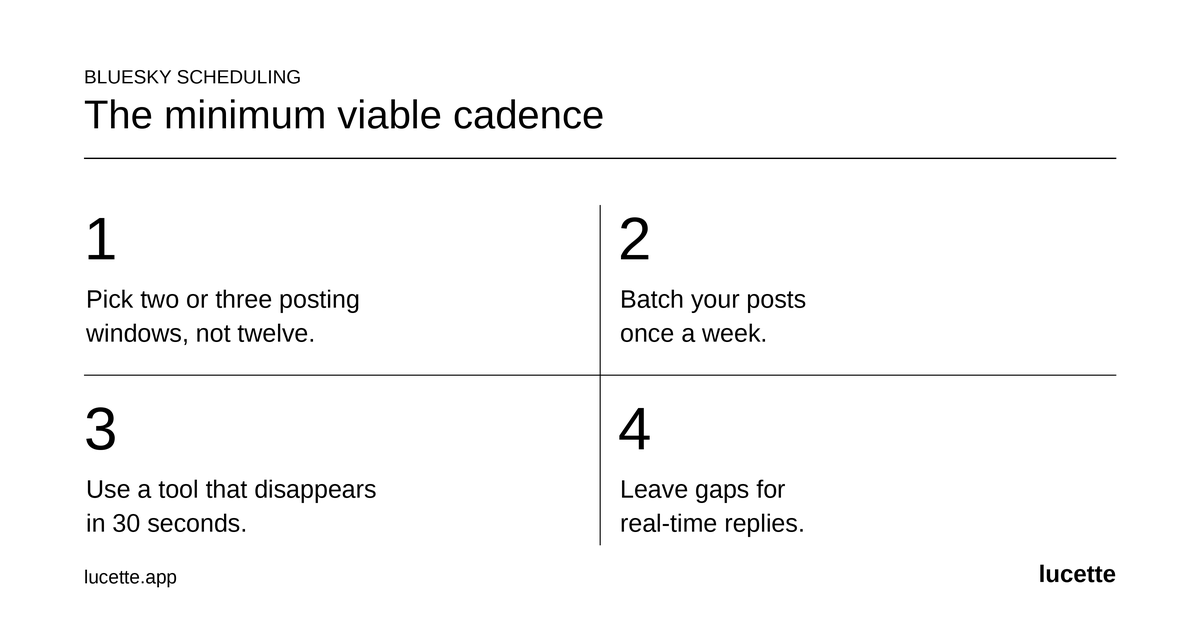
The minimum viable Bluesky cadence
So the answer isn’t a fancier system. It’s a tiny one you’ll actually keep.
- Pick two or three windows, not twelve. One Tuesday afternoon, one midday, maybe one morning. Enough to stay in the feed, few enough to sustain when you’re tired.
- Batch once a week. Spend twenty minutes writing your next few posts in one sitting, while you still have the thread of thought. Not a month of content. A week.
- Use a tool that disappears. If scheduling takes longer than writing the post, you won’t do it. The tool should be invisible: text in, time picked, done.
- Leave gaps on purpose. Bluesky rewards being there. Keep room for the live reply, the quote-post, the thing you didn’t plan. That unplanned stuff is what actually builds a community.
A real week can be smaller than you think. Three posts written on Sunday, set for one Tuesday afternoon, one Wednesday midday, and one Thursday morning, then you close the app and get back to your actual work. That’s a cadence you can hold in July and still be holding in November.
Why timing beats frequency here
The big-suite guides won’t say this, because they are quietly selling you on volume: on a chronological network, timing beats frequency.
Three posts dropped into the right windows will out-reach fifteen posts sprayed at random hours. You are not behind because you post less than someone else. You fall behind when you post into dead air, at 2 AM, to no one.
That should feel like relief. Consistency on Bluesky isn’t about grinding out more. It’s about showing up, reliably, at a few moments that count, so your people learn when to expect you.
But doesn’t scheduling make you a robot?
Fair worry, especially now, when feeds are drowning in content that reads like a machine wrote it on autopilot. But scheduling and authenticity are not opposites. A scheduling tool is for the posts you already meant to write. It handles the predictable part, the stuff you would have posted anyway, so your real attention is free for the live, unplanned, human part: the replies, the quote-posts, the hot take at 4 PM you couldn’t have planned on Monday. A queue doesn’t make you a robot. It makes room for you to be a person.
Be there for the part that matters
The reason you came to Bluesky was the conversation, not the logistics. So don’t let the mechanics of getting a post out the door eat the reason you showed up in the first place.
Schedule the predictable part. Be present for the human part.
lucette schedules your Bluesky posts in seconds: write it, pick the time or let it flow… done. No calendar to maintain, no dashboard to learn. Just a queue that shows up so you don’t have to.
-
How to schedule posts on Bluesky in 2026, Hootsuite. Bluesky has no native scheduling; a feature request exists on GitHub with no official timeline. ↩
-
Bluesky 2025 Transparency Report, January 29, 2026. Users grew from 25.94M to 41.41M in 2025; 1.41 billion posts were created, 61% of all posts in the network’s history. ↩ ↩2
-
How to schedule Bluesky posts, Sprout Social. Bluesky relies on chronological visibility, so early engagement helps posts reach discovery feeds. ↩
-
Best time to post on Bluesky in 2026 (data study), RecurPost. Weekday afternoons (1 to 3 p.m.) see the strongest engagement; 9 a.m. to 12 p.m. is a secondary window. ↩