The 20-Minute Weekly Batch That Keeps You Consistent
You open the app to post one thing. Forty minutes later you resurface, the post is up, but you’ve also read three arguments you didn’t need, checked your notifications twice, and completely lost the thread of whatever you were doing before. Then tomorrow, you do it again. And the day after that.
The posting itself took ninety seconds. Everything around it took your afternoon.
The cost isn’t the writing, it’s the switching
Nobody puts this on the “post daily” advice: the expensive part was never composing the post. It’s the context switch. Every time you drop what you’re doing to go “just post something”, you pay a tax to get back to real work afterward.
That tax is real. In interview research, Gloria Mark (UC Irvine) found that after an interruption, people typically need more than 23 minutes to get back to their original task, often handling other work first.1 A five-day posting habit isn’t five quick posts. It’s five interruptions to your actual work, each one costing real recovery time, plus however long the app kept you once it had you. You’re not spending time on content. You’re spending it on re-entry.
Do this daily and the arithmetic gets grim fast. The writing stays small. The switching quietly eats the week.
You don’t have to be there when it posts
The reason people open the app in the moment is a belief that they have to catch the right time by hand. Good news: the right time is knowable in advance, which means you can decide it on Sunday and never touch the app at 9 a.m. on a Tuesday.
The data is consistent. On Bluesky, engagement peaks Tuesday and Wednesday afternoons, roughly 1 to 3 p.m., with 9 to 11 a.m. as a solid secondary window.2 On Threads, weekday mornings between 8 and 11 a.m. reliably outperform; early engagement matters on the algorithmic For You feed, while the Following feed stays chronological.3 These windows don’t move much week to week. You can point a queue at them once and be done.
So the live, in-the-moment posting you thought was mandatory? It was never buying you anything the calendar couldn’t. Timing is a decision, not a reflex.
The 20-minute batch
Put those two facts together and the whole chore collapses into one short block a week. The workflow:
- Book one 20-minute slot, once a week. Sunday evening, Monday morning, whenever your head is clearest. This is the only time you touch “posting” all week. Treat it like an appointment, because it is.
- Brain-dump first, edit second. Spend the first few minutes listing every idea, no judgment. Then write three to five short posts from the best ones. Doing it in one sitting is faster than five separate starts, because you never pay the re-entry tax between them.
- Assign each post to a known-good window. Drop them onto the times that already work: a Tuesday afternoon, a Wednesday midday, a Thursday morning. You’re not guessing. You’re using the data.
- Queue them and quit. Load the week, close the tab, and go back to your real work or your actual life. The posts go out on their own. You show up for the replies when you feel like it, not because a box needs filling.
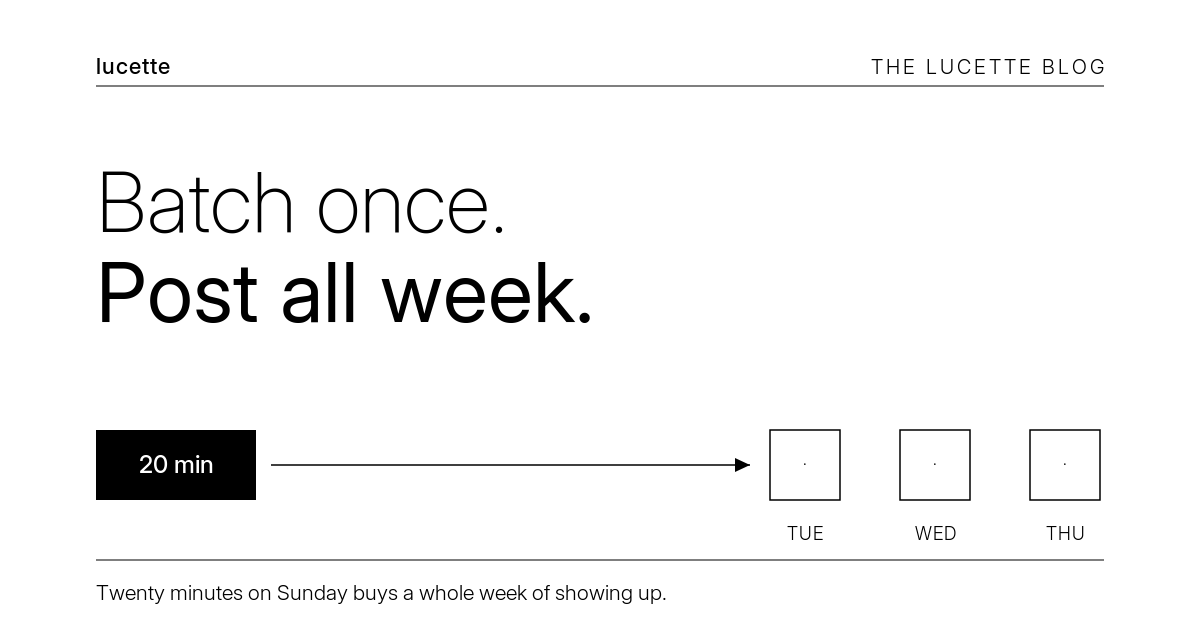
Twenty minutes on Sunday buys you a whole week of showing up. Not a month of pre-planned content you’ll abandon by the second week. Just the next few days, handled, so the rest of your time is yours.
The counterintuitive truth
Doing it all at once, less often, is what makes you more consistent, not less.
It sounds backwards, but the daily-poster is the one who falls off. They’re relying on motivation and a free moment every single day, and both run out. The batcher already did the work once, calmly, and the queue carries them through the tired days, the busy days, and the days they forget entirely. Consistency isn’t a daily act of will. It’s a system you set up once and let run. 🙂
Close the app for a week
That forty-minute spiral you fall into every time you “just post something” is not the price of being a creator. It’s the price of doing it live, one post at a time, five times a week.
Batch it. Point it at the good windows. Then close the app and don’t think about it until next Sunday. Your focus, and your afternoon, come back.
lucette is where the batch lands: write your week’s posts, drop them onto the times that work, and let the queue post them for you. Twenty seconds a post, then you’re free until next week.
-
Gloria Mark, interview in Too Many Interruptions at Work?, Gallup Business Journal. In a multi-day observational study of knowledge workers, interrupted work was typically resumed in an average of 23 minutes and 15 seconds, but people often completed other tasks before returning to the original one. Mark’s CHI 2008 paper (The Cost of Interrupted Work) found interruptions also raise stress, frustration, and mental effort. ↩
-
Best time to post on Bluesky in 2026 (data study), RecurPost. Weekday afternoons (1 to 3 p.m.) see the strongest engagement; 9 a.m. to 12 p.m. is a secondary window. ↩
-
The Best Time to Post on Threads in 2026, Buffer, based on an analysis of 2.5 million posts. Weekday mornings (roughly 6 to 11 a.m.) perform best. ↩